AI Pipeline
The route a newspaper page travels from the archive shelf to a verified historical finding. The method unfolds in four main phases; each one produces the input of the next.
- 1923–1938
- 8 periodicals
- 5,000+ target letters
- 24 months
- 6 work packages
- 01
Data Collection
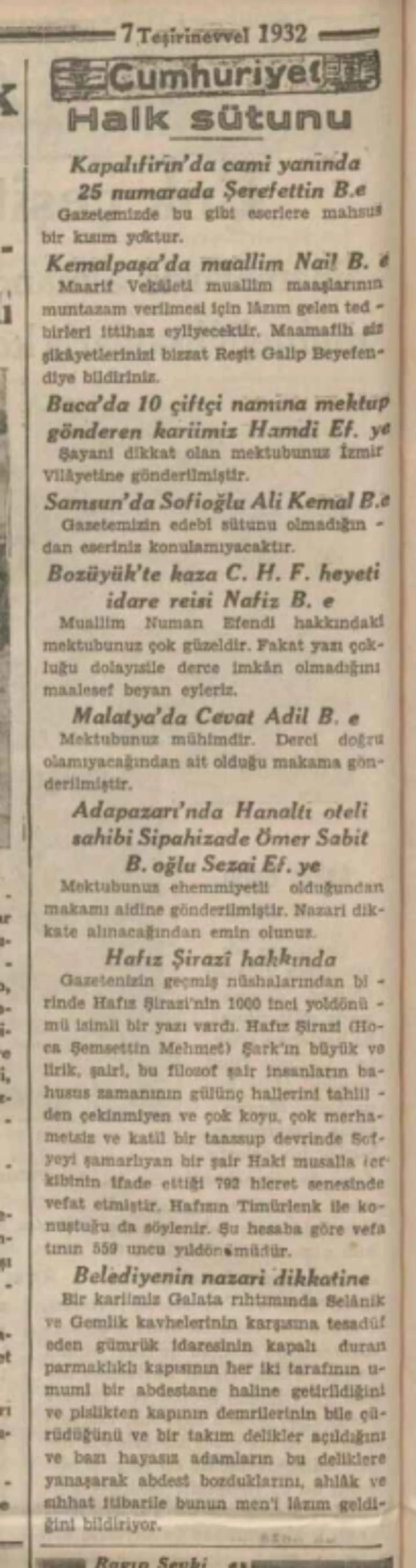
Issues of eight periodicals from across the political spectrum, published between 1923 and 1938, are surveyed to locate reader letters and front-page news covering the government agenda.
- The newspapers Cumhuriyet, Hâkimiyet-i Milliye, İkdam, Vakit, Akşam and Tanin, plus the journals Sebîlürreşâd and İctihad
- Images sourced from online collections and from archives and libraries in Ankara and Istanbul
- The preliminary study already gathered 1,100+ letters and a similar volume of news; the target is at least 5,000 letters
- Archival survey
- Chronological cataloguing
- Graduate scholars
- 02
Data Preparation and Digitization
Collected images are catalogued by newspaper, year and month; pre-1928 texts are transcribed into the modern alphabet and converted into machine-readable formats.
- Transcription from the old script into modern Turkish, assisted by Transleyt and verified manually
- OCR digitization at character, word, sentence, paragraph and page level
- Stop-word removal and lemmatization as linguistic preprocessing before analysis
- OCR
- Transcription
- XML · TEI · CSV
- 03
Modeling
The clean dataset is processed along three axes of analysis. Every task is attempted separately with classical Natural Language Processing (NLP), encoder-based language models and open-source large language models; the best performer owns that task.
- Models adapted to period Turkish through continual learning
- Thematic analysis: sentiment, keywords and topics
- Time series analysis and public–government agenda comparison
- BERTurk
- BERTopic
- KeyBERT
- LSTM
- K-Means
- 04
Evaluation and Validation
Model outputs are first tested quantitatively with task-specific metrics, then interpreted qualitatively by historians. The final step turns the findings into a holistic account of the period from a history-from-below perspective.
- Quantitative validation: F1, ROC AUC, topic coherence and perplexity
- Qualitative assessment: expert historian review and manual checks
- Cross-validation to test model reliability
- F1
- ROC AUC
- Coherence
- Perplexity
The three axes of modeling
The modeling phase asks the same dataset three separate questions: what did people feel and talk about, how did that agenda shift over time, and where did it overlap with the government's agenda?
Thematic Analysis
Unpacks the layered structure of emotions, concepts and themes in the letters.
Sentiment Analysis
Fine-grained emotion classes such as anger, hope and anxiety beyond positive, negative and neutral, using BERTurk and ELECTRA models adapted to period Turkish.
Keyword Extraction
Contextual keywords via KeyBERT, alongside iterative extraction with large language models: generate candidates, filter, then merge.
Topic Modeling
Topic maps comparing LDA, BERTopic and LLM-guided summarization, validated with coherence scores.
Time Series Analysis
Each letter becomes an embedding vector; monthly and yearly averages are processed with LSTM to trace how public sentiment and demands moved from 1923 to 1938.
- Embedding extraction
- Monthly and yearly sequences
- Pattern analysis with LSTM
- t-SNE / PCA visualization
Public–Government Agenda Comparison
The public agenda drawn from letters and the government agenda drawn from headlines are clustered separately and matched. Shared, divergent and entirely unspoken topics are read against the censorship context of the period.
- Preprocessing and embedding
- K-Means clustering
- Jaccard / cosine comparison
- Agenda analysis over time
One task, three approaches
The principle that makes the project hybrid: no method is trusted in advance. Sentiment analysis, keyword extraction and topic modeling are each attempted with three approaches; whichever scores highest on task-specific metrics owns that task.
Classical NLP
LDA, TF-IDF, word co-occurrence analysis
Encoder Language Models
BERTurk, ConvBERTurk, Turkish ELECTRA, XLM-RoBERTa
Open-Source LLMs
LLaMA 3.1, Gemma, Mistral; run locally for data security
Compared on task-specific metrics; the best method is selected
The models learn the Turkish of the 1930s
Models trained on modern Turkish can stumble over the period's vocabulary. Every model therefore goes through continual learning on a purpose-built dataset of Ottoman-rooted words and period spelling.
Work schedule
The 24-month calendar is divided into six work packages; model trials run in parallel while data collection continues.
- WP1
Data Collection and Digitization
Months 1–9
- WP2
Preliminary Model Trials
Months 3–5
- WP3
Annotation and Fine-Tuning
Months 5–12
- WP4
Manual Review
Months 10–15
- WP5
Full-Dataset Analysis
Months 16–18
- WP6
Qualitative Evaluation
Months 19–24