About the Project
325K990 - Hybrid Artificial Intelligence Models for Historical Text Analysis: A Data-Driven Investigation of Atatürk Era Reader Letters and Government Agenda
Overview
The project examines a large number of reader letters published in Turkey between 1923 and 1938 using AI-based natural language processing (NLP) and large language model (LLM) methods together with a history-from-below approach, aiming to systematically reveal the everyday demands, expectations, and criticisms of the public in Atatürk-era Turkey.
In this period of accelerating modernization, nation-state building, and strongly felt state authority, the project draws not only on reader letters but also on press coverage of the government agenda in contemporary periodicals, in order to grasp the agendas of ordinary people and understand their patterns of interaction with government policy.
The literature on reader letters has so far been shaped largely by limited data; a holistic, data-driven analysis of hundreds of letters has never been carried out, and the use of NLP models adapted to the linguistic characteristics of period Turkish remains very limited. By filling this gap, the project proposes a new conceptual and methodological framework for both the social sciences and humanities and AI research.
A Request from the War Disabled
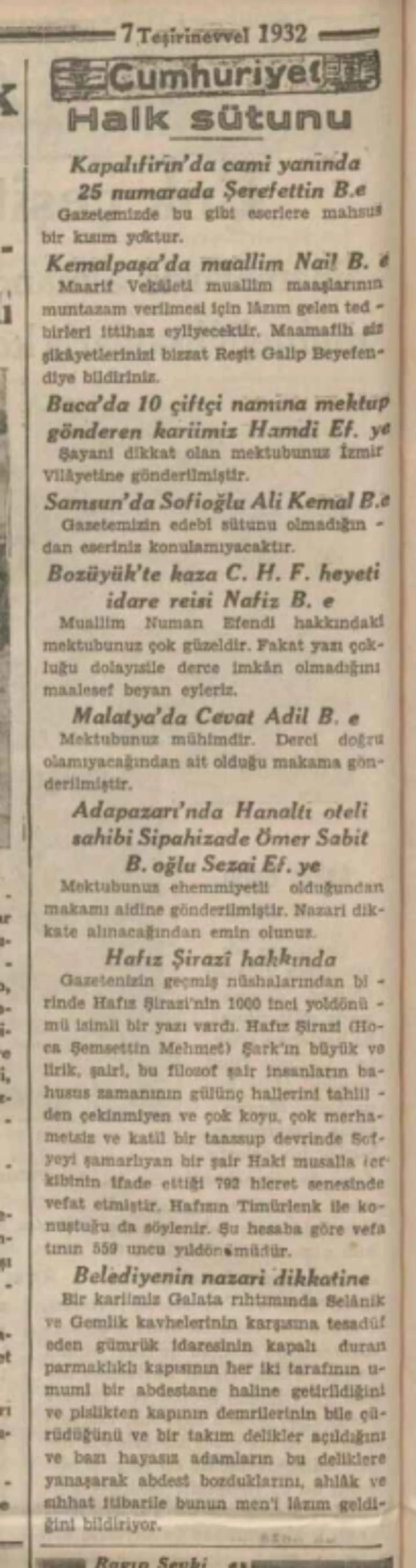
Written under the signature of RasihPERSON, one of the war disabledSOCIETY: “The promotion lawDOCUMENT of the Disabled VeteransSOCIETY passed the parliamentSTATE on February 8 and was published in the official gazetteDOCUMENT dated February 22. Although the law is valid from its publication date, its implementation has not yet started in IzmirLOCATION in any way. Although indeed many procedures are necessary for the payment of the promotion allowances added to salaries, I believe there is no obstacle in implementing the other articles of the law. The delay in implementing this law, which provides many benefits to the war disabledSOCIETY—most notably the issue of travelling at half price like active soldiersSOCIETY on transport vehicles—causes the grievance of the disabled. Furthermore, while national institutions such as DarülbedayiSTATE and cinemas are open to the disabled at half price in all Western countriesLOCATION, no one has thought of such courtesy here. The poor disabled who lost a limb on the battlefronts for the defense of the homeland and are deprived of all kinds of joy and happiness should at least be allowed to benefit from theaters and cinemas in proportion to the permission shown to officers and soldiersSOCIETY. Undoubtedly, it is also their right to have fun. In fact, they have earned it more than anyone else. But how much joy can they add to their already poisoned lives with the meager salaries they receive? I request you to draw the attention of those concerned to these matters.”
Cumhuriyet • 10 Temmuz 1932A Two-Way Analysis
Letters and government-agenda coverage are analyzed with natural language processing and large language models, and examined in two directions:
Tracking how decisions taken by the ruling apparatus affected ordinary people.
Observing whether individuals' demands, criticisms, and expectations influenced political, economic, and social policy.
The aim is to reach a holistic historical perspective.
Language Models Suited to Historical Turkish
To analyse the period-specific vocabulary, idiomatic expressions, and forms of expression found in reader letters from 1923 to 1938 as accurately as possible, the project draws on language models suited to historical Turkish alongside a range of AI-based text analysis approaches. This framework is intended to ensure that the distinctive linguistic characteristics of historical texts are taken into account throughout the analytical process, while enabling the combined use of models and methods appropriate to different research tasks.
Data Sources
To hear the voices of broad segments of society, a dataset of periodicals representing different political perspectives was selected: the newspapers Hâkimiyet-i Milliye (Ulus) and Cumhuriyet, close to the government and published throughout almost the entire research period; the newspapers İkdam, Vakit (Kurun), Akşam, and Tanin, addressing different segments of society; and issues of the journals Sebîlürreşâd and İctihad.
Funding and Institutions
TÜBİTAK 3005 — Program for Innovative Solutions in Social Sciences and Humanities Research Projects
The project is funded for a period of 24 months.
The project is carried out with an interdisciplinary approach, bringing together researchers from Pamukkale University (the Department of History in the Faculty of Humanities and Social Sciences, and the Department of Artificial Intelligence and Data Engineering) and İzmir Institute of Technology.
Meet the team